NB
PROTECTIVE FILMS
NB
PROTECTIVE FILMS
Mar. 18, 2024
In the protective film industry, PE protective film and PET protective film are two common materials used to protect surfaces from scratches, dust, stains, abrasion and handling damage during manufacturing, transportation, storage and installation. Although both materials are used for surface protection, they have different performance characteristics and are suitable for different applications. PE protective film is usually preferred for temporary surface protection on aluminum profiles, stainless steel sheets, glass, plastic parts, household appliances and building materials because it is flexible, cost-effective and easy to remove. PET protective film is more suitable for applications requiring higher transparency, tensile strength, abrasion resistance, solvent resistance, dimensional stability or heat resistance, such as electronic screens, optical surfaces, battery insulation, high-temperature processing and precision components. Understanding the difference between PE and PET protective film helps manufacturers choose the right film material, adhesive level, thickness and roll size before bulk production.
| Factor | PE Protective Film | PET Protective Film |
|---|---|---|
| Full Material Name | Polyethylene | Polyethylene Terephthalate / Polyester |
| Flexibility | Higher flexibility and conformability | More rigid and dimensionally stable |
| Transparency | Good, depending on grade | Excellent optical clarity |
| Tensile Strength | Good for general surface protection | Higher tensile strength |
| Abrasion Resistance | Suitable for general anti-scratch protection | Better abrasion and wear resistance |
| Heat Resistance | Suitable for normal temperature applications | Better for higher temperature or precision applications |
| Chemical Resistance | General resistance | Better solvent and chemical resistance |
| Removal Performance | Easy peel for temporary protection | Clean removal when adhesive is properly selected |
| Typical Cost | More economical | Usually higher than PE |
| Best For | Metal sheets, aluminum profiles, glass, plastic parts, appliances | Electronics, displays, battery insulation, optical surfaces, high-temperature protection |
PE protective film is made from polyethylene, a flexible and widely used plastic material. It is one of the most common options for temporary surface protection because it offers good flexibility, easy application and cost-effective protection for large-area surfaces. PE protective films are commonly used to protect stainless steel, aluminum, glass, plastic sheets, decorative panels, household appliance surfaces, doors, windows and construction materials. They help prevent scratches, dust, moisture, fingerprints and minor impact damage during production, handling, transportation and installation. For manufacturers who need flexible and economical surface protection, PE protective film is often the first choice. It can be customized by thickness, adhesive strength, color, printing, roll width and application period.
Cost-effective solution for temporary surface protection
Flexible and easy to apply on flat or slightly curved surfaces
Suitable for aluminum, stainless steel, glass, plastic and appliance panels
Available in different thicknesses and adhesive levels
Easy to peel off when the adhesive is properly matched
Can be customized by width, color, printing and roll length
For aluminum surface protection, you can learn more about our protective film for aluminium profiles and plates. For metal sheet applications, PE protective film is also widely used for protective film for stainless steel sheets.
PET and polyester films are both polymer-based films, consisting of polymer chains. Although they are both classified as polyester, their physical properties differ.
PET film generally outperforms polyester film in terms of durability due to its superior tensile strength and height resistance to impact. They also boast better heat resistance, capable of withstanding higher temperatures than polyester films. Additionally, PET films offer superior clarity, making them a prime choice in applications where transparency is paramount.
In contrast, polyester films tend to be softer and more pliable than PET films, rendering them ideal for scenarios necessitating puncture resistance and flexibility. Polyester films also exhibit superior electrical properties, capable of handling higher voltages in comparison to PET films.
The chemical properties of PET and polyester films differ as well. PET films generally display greater resilience to chemical aggression than their polyester counterparts, making them a preferable choice in applications demanding chemical resistance. Conversely, polyester films exhibit heightened resistance to ultraviolet (UV) radiation, rendering them suitable for outdoor applications.
Furthermore, PET films tend to resist staining and discoloration more effectively than polyester films, making them a sound choice in applications where aesthetics hold significance.
When selecting the appropriate film for a particular application, one should carefully consider the physical and chemical properties of PET and polyester films. PET films excel in terms of durability, heat resistance, and chemical resistance, making them ideal for scenarios requiring these attributes. In contrast, polyester films offer superior flexibility and puncture resistance. Each type also boasts distinct electrical and UV properties, rendering them well-suited to varying applications. A comprehensive understanding of these properties empowers individuals to make informed decisions regarding film selection.
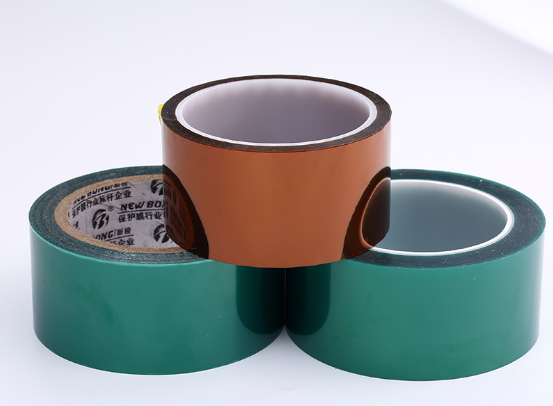
Pet High Temperature Protective Films
PE's flexibility and impact resistance makes it ideal for applications where toughness and durability are essential. PET's higher tensile strength and rigidity make it suitable for applications requiring structural integrity and stiffness.
Polyethylene (PE) is a thermoplastic polymer known for its versatility and cost-effectiveness. PE protective films are typically made from low-density polyethylene (LDPE) or high-density polyethylene (HDPE). LDPE offers flexibility and conformability, making it suitable for irregularly shaped surfaces, while HDPE provides higher strength and puncture resistance.
Application: PE protective films find widespread use in industries ranging from construction and automotive to electronics and furniture. They are commonly applied to surfaces such as stainless steel, aluminum, glass, and plastic sheets to protect against scratches, dirt, moisture, and minor impacts during handling, transportation, and installation processes.
Characteristics: PE protective films are characterized by their easy peelability, allowing for quick application and removal without leaving adhesive residue. They offer temporary protection without altering the appearance or properties of the underlying surface. PE films are available in various thicknesses, ranging from thin, economical options to thicker, more durable grades for heavy-duty applications.
PET protective film is made from polyethylene terephthalate, also known as polyester film. Compared with PE film, PET protective film usually has higher tensile strength, better dimensional stability, better abrasion resistance, excellent transparency and stronger resistance to solvents and chemicals. Because of these properties, PET protective films is often used for electronic surfaces, optical components, displays, touch panels, battery insulation, high-value panels and applications requiring clean appearance or stable film performance. PET protective film is also suitable for some applications that require higher temperature resistance. For demanding process conditions, buyers can consider PET high-temperature protective films.
Excellent optical clarity and surface appearance
Higher tensile strength and dimensional stability
Better abrasion resistance than general PE film
Good solvent and chemical resistance
Suitable for electronic screens, displays and precision surfaces
Can be used for battery insulation and high-temperature applications
Clean peel performance when matched with the right adhesive system
| Application | Recommended Film | Reason |
|---|---|---|
| Aluminum profiles and plates | PE protective film | Flexible, cost-effective and suitable for cutting, transport and installation |
| Stainless steel sheets | PE protective film or customized PET film | PE is suitable for general protection; PET can be used when higher abrasion resistance is needed |
| Glass and mirrors | PE or PET protective film | PE is suitable for general protection; PET is better for higher clarity and surface stability |
| Household appliance panels | PE protective film | Suitable for temporary protection during assembly, storage and delivery |
| Electronic screens and touch panels | PET protective film | Better transparency, dimensional stability and scratch resistance |
| Power battery insulation | PET protective film | Better insulation, tensile strength and temperature stability |
| High-temperature processing | PET high-temperature protective film | Better heat resistance and stable performance |
| Plastic parts and surfaces | PE protective film | Better flexibility and easier application on irregular surfaces |
PE protective film is a better choice when your application requires temporary, flexible and cost-effective surface protection. It is especially suitable for manufacturers who need to protect large-area surfaces during production, storage or transportation. Choose PE protective film if your application requires:
Temporary surface protection during manufacturing, storage or transportation
Flexible film for aluminum profiles, stainless steel sheets, glass, plastic parts or appliance panels
Cost-effective protection for large-area surfaces
Easy application and clean removal
Custom adhesive level, film thickness, roll width, color or printing
PE protective film is commonly used for protective film for household appliances, protective film for glasses and mirrors, aluminum profiles, stainless steel sheets and plastic surface protection.
PET protective film is a better choice when the surface requires higher clarity, stronger mechanical performance or better stability under demanding conditions. It is commonly used for high-value surfaces where appearance, dimensional stability and clean protection are important. Choose PET protective film if your application requires:
Higher transparency and optical clarity
Better tensile strength and dimensional stability
Stronger abrasion and solvent resistance
Higher temperature resistance
Electronic surface protection, battery insulation or precision component protection
Clean appearance for high-value surfaces
For electronic and battery-related applications, you can also view our electronic film and battery film solutions.
Choosing between PE protective film and PET protective film should not be based only on material name. Buyers should confirm the surface, process and removal requirements before bulk production.
| Parameter | Why It Matters |
|---|---|
| Surface material | Aluminum, stainless steel, glass, plastic and electronic surfaces require different adhesive levels |
| Surface finish | Smooth, brushed, coated, mirror and textured surfaces need different tack strength |
| Film thickness | Affects protection strength, flexibility, durability and cost |
| Adhesive strength | Determines whether the film stays stable and removes cleanly |
| Application period | Longer protection may require better adhesive stability |
| Temperature condition | High-temperature processes may require PET protective film |
| Transparency requirement | Optical surfaces and display panels usually require PET film |
| Roll width and length | Should match the production line, product size and application method |
| Removal requirement | Residue-free removal is critical for finished and decorative surfaces |
PE protective film is usually more economical and is suitable for many general surface protection applications. If the protected surface is large, the application period is short to medium, and the main purpose is to prevent scratches, dust and contamination, PE protective film is often the most practical choice. PET protective film usually has a higher material cost, but it offers better dimensional stability, optical clarity, abrasion resistance and temperature resistance. If the protected surface is sensitive, high-value or requires stronger performance, PET protective film may reduce the risk of defects, scratches or process failure. For many industrial buyers, the best choice is not simply the cheapest film. The right protective film should match the surface finish, process conditions and final removal requirements. A film that is not properly selected may cause edge lifting, bubbles, adhesive residue or surface damage, leading to higher rework costs.
Residue may occur when the adhesive is too strong, the film stays on the surface for too long, or the film is exposed to high temperature or UV conditions. For decorative aluminum, stainless steel, glass or electronic surfaces, residue-free removal should be confirmed before bulk orders.
If the adhesive is too weak, the film may lift during cutting, forming, transportation or storage. Textured, brushed or coated surfaces may require customized adhesive strength.
For optical surfaces, display panels or high-gloss products, poor transparency may affect inspection or appearance. PET protective film is often preferred when optical clarity is important.
PE film is flexible, but it may not offer the same dimensional stability as PET film. For precision components or high-temperature processes, PET protective film may perform better.
Difficult removal can result from incorrect adhesive selection, long application time or unsuitable storage conditions. Sample testing is recommended before mass production.
Before placing a bulk order, sample testing helps confirm whether the selected PE protective film or PET protective film works well with the actual surface and production process. A proper sample test should check:
Initial adhesion on the actual surface
Edge lifting during handling or transport
Bubble formation during application
Scratch and abrasion protection
Performance after storage or temperature exposure
Clean removal without adhesive residue
Compatibility with cutting, bending, assembly or delivery conditions
NB Protective Film can recommend suitable material, thickness, adhesive level and roll size according to your product surface and production requirements.
NB Protective Film supplies customized PE protective film and PET protective film for manufacturers in metal processing, aluminum profiles, stainless steel sheets, glass and mirror products, household appliances, electronics, battery insulation and industrial surface protection. We support customers with:
Custom film material selection: PE, PET and high-temperature PET film
Custom adhesive levels for different surfaces
Residue-free removal under proper application conditions
Different film thicknesses, colors, widths and roll lengths
Printed protective film options for branding or process identification
Sample testing support before bulk production
Factory direct supply for industrial protective film applications
Whether you need PE protective film for general surface protection or PET protective film for high-clarity, high-strength or heat-resistant applications, our team can help you select a suitable solution.
The main difference is material performance. PE protective film is more flexible and cost-effective for general temporary surface protection, while PET protective film offers better tensile strength, transparency, dimensional stability, abrasion resistance and heat resistance.
In most cases, PE protective film is more economical than PET protective film. It is widely used for large-area surface protection on aluminum, stainless steel, glass, plastic and household appliance panels.
PE protective film is commonly used for aluminum profiles, aluminum sheets and aluminum plates because it is flexible, easy to apply and cost-effective. For high-temperature or special precision applications, PET protective film may be considered.
PET protective film is usually better for electronic screens and touch panels because it provides better optical clarity, dimensional stability and abrasion resistance.
Yes. PET protective film is commonly used for battery insulation because it offers good insulation performance, tensile strength and temperature stability. It is suitable for electronic film and battery film applications.
PE protective film can be removed cleanly when the adhesive level, application period and storage conditions are properly selected. Residue problems usually come from unsuitable adhesive, long exposure time, high temperature or UV aging.
PET protective film generally has better heat resistance than PE protective film. For higher temperature processes, PET high-temperature protective film is recommended.
The adhesive level should be selected according to surface material, surface finish, application period and removal requirement. Smooth, textured, coated, brushed and mirror surfaces may require different tack levels.
- PE Protective Film:
PE protective films typically come with adhesive coatings that provide temporary bonding to the surface they are applied to. The adhesive strength of PE films can vary, ranging from low-tack to high-tack, depending on the specific application requirements. Low-tack PE films are easier to remove without leaving residue, while high-tack films offer stronger adhesion for more challenging surfaces.
- PET Protective Film:
PET protective films also come with adhesive coatings, but the adhesive strength may not be as strong as some PE films. The focus of PET films is often on providing superior clarity and optical properties rather than extremely aggressive adhesion. PET films are more commonly used for protection against scratches and dust rather than heavy-duty protection.
- PE Protective Film:
PE is a widely used and recyclable plastic. However, its recyclability can depend on the specific additives and coatings used in the protective film. Some PE films are easily recyclable, while others may require specialized recycling processes due to the presence of adhesives or other additives.
- PET Protective Film:
PET is also a recyclable material, and many PET protective films can be recycled through existing recycling processes for PET plastics. PET's recyclability makes it an environmentally friendly option for certain applications.
- PE Protective Film:
PE is generally more affordable than PET, making PE protective films a cost-effective choice for many applications. The availability of PE films in various thicknesses and adhesive strengths also allows for more flexible pricing options.
- PET Protective Film:
PET films are often considered a higher-end option due to their optical clarity and dimensional stability. As a result, PET protective films may be more expensive than PE films, especially in applications where high transparency and UV resistance are essential.
- PE Protective Film:
PE protective films are available in a wide range of thicknesses, with thicker films offering higher durability and puncture resistance. PE films are generally flexible and conform well to curved surfaces.
- PET Protective Film:
PET films are known for their excellent tensile strength and dimensional stability, even in thin gauges. Thinner PET films can offer good protection against scratches and dust without compromising optical clarity.
PE protective film and PET protective film both play important roles in industrial surface protection, but they are designed for different performance requirements. PE protective film is flexible, economical and suitable for general temporary protection on aluminum, stainless steel, glass, plastic and appliance surfaces. PET protective film provides higher transparency, tensile strength, abrasion resistance, solvent resistance and temperature stability, making it more suitable for electronics, displays, battery insulation and high-value surfaces. If you are not sure whether PE protective film or PET protective film is better for your product, please send us your surface material, surface finish, application process, required protection time, temperature condition, roll size and removal requirement. Contact NB Protective Film for sample testing and a customized protective film recommendation before bulk production.

Navigation
+86 158 1691 5404
+86 757 8271 3937
+86 757 8271 3937
No. 10 Industry Huacongsiyue Village, Shishan Town, Nanhai District, Foshan, Guangdong Province, China